Hi there,
Property markets are moving at different speeds, while the outlook for fixed interest rates has shifted. Here is what borrowers and homeowners should know this month.
This Month at a Glance
National sales slowed in August, Auckland and Wellington buyers had more time to decide, and the South Island remained comparatively resilient. At the same time, major-bank pricing shows that fixed rates do not all move in the same direction or simply follow the OCR.
Housing Market
New Zealand Market Update
The August 2026 data points to a market holding its value better than its pace. Activity eased, homes took longer to sell and available stock stayed elevated, giving many buyers time to compare options and negotiate.
| National Median $750,000 ↓ 1.3% year on year | Sales 5,430 ↓ 13.0% year on year | Days to Sell 51 3 days longer than Aug 2025 | Inventory 32,908 ↑ 9.7% year on year | |
Regional Snapshots
| Auckland 54 days to sell The median price was unchanged from August 2025, but homes took longer to sell than the 10-year August average of 43 days. Inventory has now grown year on year for 31 consecutive months, keeping choice high. | Wellington 60 days to sell The region recorded its lowest August sales count on record. The median selling time was well above the 10-year August average of 41 days, while prices remained 30.3% below their peak. | Queenstown / Otago South Island momentum Otago’s House Price Index was 3.5% higher year on year and only 1.1% below its peak. Queenstown Lakes remains a high-value, affordability constrained market; nearby Central Otago recorded an August median of $895,000. | |
What This Means Buyers may have more negotiating room in Auckland and Wellington, but good properties still attract attention. In Queenstown and the wider Otago market, stronger price momentum and affordability constraints make finance preparation especially important. | |
Source note: REINZ August 2026 figures, as reported 15 September 2026; HUD affordability data runs to December 2025. Figures are broad market indicators and may not reflect an individual property.
First-Home Buyers
First-home buyers remain the largest buyer group
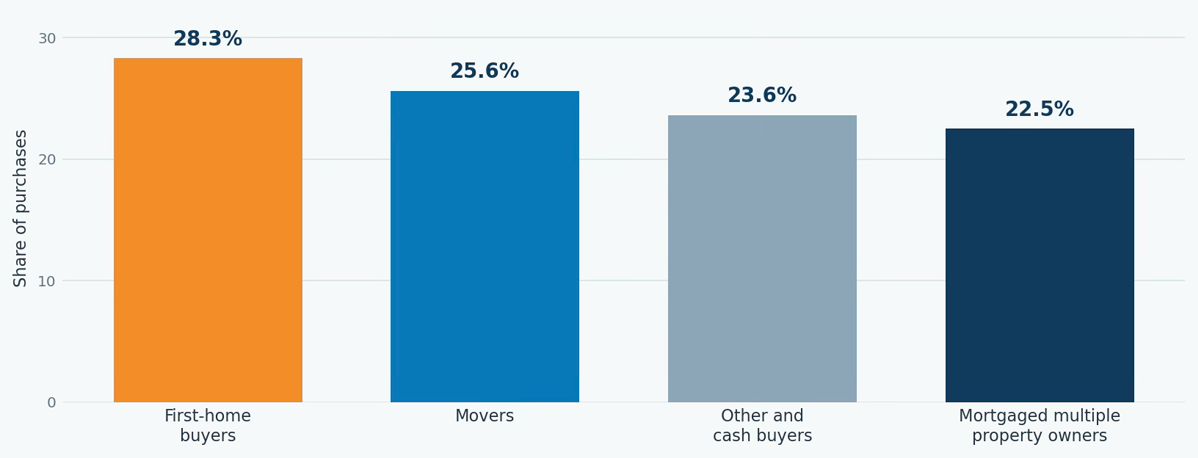
First-home buyers accounted for a record 28% of nationwide property purchases in the three months to June 2026, making them the largest single buyer group in the market. This is not only a larger share of a quieter market: Cotality reports that first home buyer transaction numbers are also rising, with about 24,950 purchases over the latest 12 months.
Nationwide buyer share, April to June 2026. “Other and cash buyers” is the calculated balance of all other Cotality buyer categories. Source: Cotality Buyer Classification data.
Why first-home buyers are active
High listing levels are giving buyers more choice and negotiating power. Values remain below their peak in many regions, while KiwiSaver withdrawals, lower mortgage rates than at the previous peak and banks’ low deposit lending allowances are helping eligible purchasers enter the market. Movers and mortgaged investors have been more cautious, so first home buyers are facing less competition from some traditional buyer groups.
What makes us valuable to first-home buyers
Buying a first home can feel unfamiliar and complicated. We hold your hand through the whole process, explain each decision in plain language and keep the bank, lawyer and other professionals moving toward settlement.
| A clear buying range We quickly calculate a realistic maximum purchase price using your income, deposit, KiwiSaver, debts and expected repayments. | More lending pathways We compare mainstream bank options and consider low-deposit lending, new build policies and Kāinga Ora First Home Loans where eligible. | Offer ready guidance We help with pre-approval, finance conditions, valuation requirements and property specific checks before you become committed. | | A stronger application We present your income, deposit and account conduct clearly and address likely lender questions early. | Loan structure explained We make rates, repayments, fixed terms, offsets and revolving credit easy to understand before you choose. | Support through settlement We coordinate with the bank, lawyer and other professionals, track conditions and keep the process moving to drawdown. | |
Market-share figures describe national purchasing activity and do not predict future prices or the result of an individual application. Lending criteria and eligibility requirements apply.
Borrowing
Fixed rates may be turning higher
The direction of fixed mortgage rates has become less straightforward. Inflation risks, higher wholesale funding costs and global uncertainty have pushed parts of the fixed-rate curve higher even as banks compete aggressively at selected terms.
| OCR 2.75% after a 25bp rise on 2 September | Westpac mixed move 6m, 1y and 3–5y up; 2y down | BNZ mixed move 6m, 1y and 3–5y up; 2y down | |
What changed?
- Westpac lifted several fixed terms from 21 September: its six-month special moved to 4.89%, one-year to 5.19%, three-year to 5.59%, and four- and five-year terms to 5.65% and 5.75%. Its two-year special fell to 5.29%.
- BNZ followed on 22 September, lifting its six- and 12-month and three- to five-year fixed rates, while holding its competitive 18-month offer and trimming its two-year rate.
- Expectations have shifted toward further OCR increases. The timing and extent remain uncertain, so today’s best structure depends on your budget, loan split, refix dates and tolerance for change.
A useful reminder Fixed rates reflect more than the OCR. Wholesale rates, bank funding costs, deposit pricing and competition can move individual terms in different directions. A “wait and see” approach carries a real risk that some offers will be higher later. | |
Practical steps for borrowers
| Refixing soon? Review options before expiry and compare total cost not only the headline rate. | Buying now? Secure pre-approval early and build repayment buffers into your budget. | | Want flexibility? Consider whether splitting the loan across different terms suits your cash flow and risk preferences. | Already fixed? Check break costs and the full financial impact before changing an existing loan. | |
Rates and forecasts can change without notice. This is general information, not personalised financial advice. Eligibility, lending criteria and terms apply.
This Month’s Blog
Level vs stepped premiums
Choosing the right premium structure is not simply about finding the lowest price today. It is about matching affordability now with the length of time you expect to keep your cover.
| Stepped Premiums Lower at the start Premiums generally rise as you get older. This can make cover more affordable initially, but the cost may become significantly higher over time. | Level Premiums More certainty Premiums usually start higher but are designed to stay more stable for the selected level-premium period. They may suit people planning to keep cover for the long term. | |
The important fine print
“Level” does not necessarily mean the premium can never change. Inflation-linked benefit increases, policy alterations, insurer repricing and the specific terms of the contract can still affect what you pay. The right choice depends on your age, budget, circumstances and how long you expect to need the cover.
There is no universal winner Stepped premiums can preserve cash flow today; level premiums can improve predictability over time. An adviser can model the longer-term cost and help you decide whether one structure or a combination best fits your plan. | |
Level vs Stepped Premiums — Choosing the Right Structure for Your Insurance
Insurance advice, built around your needs
Our insurance advisers can help review life, trauma, income protection, health and general insurance needs, including whether your existing premium structure still suits your budget and long-term goals.
Our Insurance Team
Meet Allister and Thurl
Our insurance team works alongside our mortgage advisers so clients can consider their lending and personal protection needs together. Allister and Thurl bring practical, experienced advice and help make the insurance process clear and manageable.
Talk with us Whether you are buying, refinancing, refixing or reviewing your insurance, our team can help you understand the options and make a plan with confidence. | |