Level vs Stepped Premiums: Choosing the Right Structure for Your Insurance
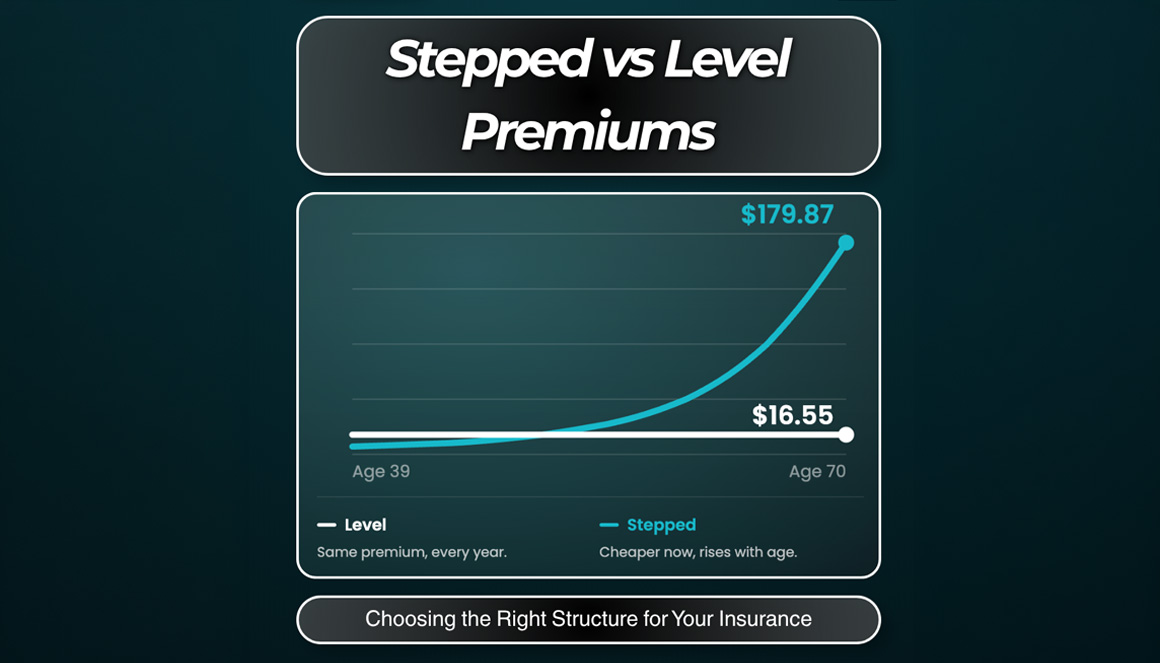
Why the structure of your insurance premiums can make such a big difference.
When arranging personal insurance, it’s natural to focus on how much cover you need and what you want to protect. But just as important is how you pay for that cover and how long you expect to keep it.
Two common approaches are stepped and level premiums. Neither is automatically better. The right structure depends on your age, budget, financial circumstances and expected timeframe.
Stepped premiums
With stepped premiums, the cost of your insurance generally increases as you get older.
The advantage is a lower initial premium, which can make this structure attractive when you’re younger or don’t expect to hold the cover for an extended period.
The trade-off is that premiums can become significantly higher over time.
Level premiums
Level premiums generally involve paying more initially in exchange for greater certainty around the cost of your cover over the selected premium period.
This can suit someone who expects to retain their insurance for many years and wants greater predictability around future premiums.
“Level” doesn’t necessarily mean the premium can never change. Inflation adjustments, policy changes and other terms can still affect what you pay.
So, which is right for you?
There isn’t a universal answer.
For some people, keeping the initial cost lower with stepped premiums may be the priority. For others, paying more now for greater long-term certainty may be preferable.
Some policies also provide Special Events Increase options, allowing cover to be increased following certain life events without further medical information, subject to the insurer’s terms and limits.
Qualifying events can include marriage, having or adopting a child, purchasing a home or increasing a mortgage, receiving a significant salary increase, and other specified events.
This can provide valuable flexibility as your financial responsibilities develop.
The cheapest option today isn’t necessarily the most affordable over the life of your policy — and the most expensive option isn’t automatically the best.
Insurance Advice Company can help you consider which premium structure best fits your circumstances.
More Than Insurance: Your Financial Advice Hub
Your mortgage, insurance and wider financial commitments don’t exist independently.
A change in one area can have implications elsewhere. Buying a home, for example, changes both your lending requirements and the financial risks you may need to protect against.
That’s where having access to a broader financial advice hub can make things simpler.
The wider group brings together Mortgage Advice Company and Insurance Advice Company, with advice available across mortgages, personal insurance and general insurance.
One relationship, multiple needs
Instead of navigating different providers and advisers for every financial decision, clients can access advice across connected areas through the wider group.
That might include:
- Mortgages and lending
- Life and trauma insurance
- Income and mortgage protection
- Health insurance
- House and contents insurance
- Vehicle and other general insurance.
The benefit isn’t simply convenience. Having a broader understanding of a client’s circumstances allows different financial decisions to be considered alongside one another.
A relationship that can evolve
Financial needs naturally change over time.
You might buy your first home, have children, change careers, increase your income, start a business or pay down significant debt.
Having an ongoing advice relationship means you have somewhere to turn when those changes occur.
And the right advice won’t always mean taking out more insurance or changing your mortgage. Sometimes the best recommendation is to reduce cover, restructure an existing arrangement, or leave things as they are.
The aim is straightforward: make financial advice more connected, easier to navigate and relevant to where you are now.
Your Insurance Isn’t Set and Forget
Insurance is designed around your financial circumstances.
The problem is that those circumstances rarely stay the same.
Your income changes. Your mortgage changes. Your family grows. You change jobs, start a business, build investments or pay down debt.
Yet your insurance can remain exactly as it was when you first arranged it.
Too little, or too much?
Changes in your circumstances can create gaps in your protection.
Perhaps your income has increased substantially but your Income Protection hasn’t been updated. Maybe you’ve taken on a larger mortgage or now have children financially dependent on you.
The opposite can also happen.
Your mortgage may have reduced, your children may have become independent, or you’ve accumulated enough assets that your original level of cover is no longer necessary.
What should a review look at?
A review isn’t automatically about increasing your insurance.
It should consider whether your existing arrangements still make sense.
That might mean:
- Increasing or reducing cover
- Changing the type of cover
- Adjusting waiting or benefit periods
- Reviewing premium structures
- Identifying gaps or overlaps
- Confirming that your current arrangements remain appropriate.
A review can be particularly valuable following a major change such as buying or refinancing a home, having a child, changing jobs, receiving a significant pay rise, starting a business or taking on substantial debt.
Insurance shouldn’t be based on a snapshot of your life from five or ten years ago.
It should keep pace with the financial position you’re actually in.
When Insurance Matters Most: What Do Claims Tell Us?
“Do insurance companies actually pay claims?”
It’s one of the most common questions people have about insurance.
The short answer is that New Zealand insurers pay hundreds of millions of dollars in claims each year across life, trauma, income protection and other forms of personal insurance.
For example, AIA reported more than $790 million in claims paid during 2025, while Fidelity Life reported more than $247 million during its 2024/25 reporting period.
But what are people actually claiming for?
What are the common claims?
The answer varies depending on the type of cover.
For Life and Trauma Cover, cancer, heart conditions and neurological conditions feature prominently in claims data.
Income Protection is different. Claims can arise from conditions including musculoskeletal problems, mental health conditions and neurological conditions — demonstrating that an event doesn’t necessarily have to be life-threatening to significantly affect someone’s ability to work.
For many people, their income is their most valuable financial asset.
The policy matters
Claims statistics provide useful context, but they don’t determine whether an individual claim will be paid.
Each claim is assessed against the specific terms of the policy, including its definitions, exclusions, waiting periods and benefit requirements.
That’s why understanding what your policy actually covers is just as important as understanding the premium.
Ultimately, insurance is about transferring a financial risk that could otherwise be difficult for you or your family to absorb.
The important question isn’t simply:
“Will I ever claim?”
It’s:
“If something happened to me, could my finances cope without it?”
One Hub. Comprehensive Advice.
Your financial decisions are connected.
That’s why Mortgage Advice Company and Insurance Advice Company bring together advice across mortgages, personal insurance and general insurance.
Whether you’re buying a home, protecting your income, reviewing existing cover or navigating a change in circumstances, our aim is to make financial advice simpler, more connected and easier to navigate.
One relationship. Multiple areas of advice. A team that can help as your needs evolve.
Mortgage Advice Company. Insurance Advice Company. Your financial advice hub.
Need mortgage or insurance advice?